The foundation of every Muslim’s Faith in Practice
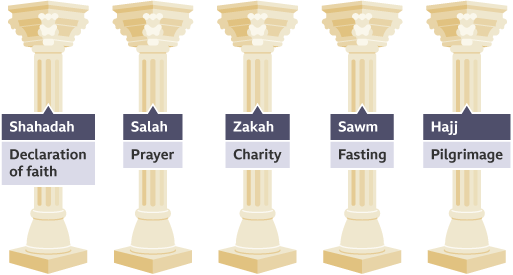
Islam is built on five foundational acts of worship, known as the Five Pillars.
These pillars represent a Muslim’s relationship with God and with the wider community. Together, they serve as a guide for how to live a life of devotion, discipline and purpose.
The Prophet Muhammad has been quoted saying “Islam has been built on five [pillars]:
Shahadah [testifying that there is no god except Allah and that Muhammad is the Messenger of Allah], performing the Salah [prayers], paying the Zakah [compulsory charity], making the Hajj [pilgrimage to the Kaaba], and Sawm [fasting] in the month of Ramadan.
– Authentic Hadith in Sahih Al-Bukhari and Sahih Muslim
Pillar 1 – Shahadah
The declaration of faith in one God (Allah) and His messenger (peace be upon him).
In Islam we use the Arabic word for God – Allah. Allah is the very same God worshipped by Abraham, Noah, Moses and Jesus. Allah is the creator and sustainer of all that exists in the Universe. People may know Allah by other names in other languages but anyone referring
We believe Prophet Muhammad ﷺ was a Prophet and Messenger of God. He was a righteous man and a source of guidance for all of God’s creation. He received the direct word of God through revelation brought to him by Angel Gabriel [Jibril / The Holy Spirit]. This revelation is the Quran which is the complete and final scripture addressed and sent to humanity.
Read more about Prophet Muhammad ﷺ [HERE]
And Read more about the Holy Quran [HERE]
Pillar 2 – Salah
Muslims are required to pray five times a day: at dawn (Fajr), noon (Dhuhr), mid-afternoon (Asr), sunset (Maghrib), and night (Isha). Each prayer includes Qur’anic recitation and a series of physical movements – standing, bowing, and prostrating – all of which express humility, gratitude, and submission to God.
Prayer is a direct connection between the worshipper and their Creator. It instils discipline, peace, and mindfulness, reminding Muslims that worship is woven into daily life – not confined to a specific time or place.
Pillar 3 – Zakah
Zakah is the annual obligation to give 2.5% of one’s surplus wealth to those in need. More than a charitable act, it is a divinely ordained system of social justice that purifies wealth and fosters compassion.
Funds are distributed to support orphans, the poor, those in debt, and community welfare projects. Islam teaches that wealth is a trust from God — and that true prosperity comes from sharing, not hoarding.
Pillar 4 – Sawm
During the month of Ramadan, Muslims fast from dawn to sunset, abstaining from food, drink, smoking, and marital relations during daylight hours. But fasting is more than physical abstention — it is a spiritual discipline that nurtures patience, gratitude, and self-control.
It serves as a reminder of the blessings we enjoy and the struggles faced by those less fortunate. Ramadan is also a time of increased prayer, charity, reflection, and unity. The fast is broken each evening with a meal called Iftar, often shared with family, friends, and the community.
Pillar 5 – Hajj
Hajj is the sacred pilgrimage to Mecca, required once in a lifetime for every Muslim who is physically and financially able. Performed during the Islamic month of Dhul-Hijjah, it unites millions of Muslims from every nation, culture, and background.
Men wear special garments called ihram — two simple, white, unstitched cloths draped over the body — symbolising equality before God. In ihram, there is no distinction between rich or poor, king or servant; all stand equal regardless of race, nationality, or social status.
The pilgrimage includes sacred rites such as circling the Kaaba, walking between the hills of Safa and Marwah, standing in prayer at Arafat, and casting pebbles at the symbolic devil in Mina. Hajj is both a physical and spiritual journey — a powerful experience of humility, forgiveness, and unity.
Living the Pillars
The Five Pillars are more than rituals; they are a framework for a life of purpose, compassion, and justice. They connect the soul to God and the heart to humanity — shaping personal character and building a society founded on faith, equality, and care for others.
Last edited:
Saad Dastagir
sd@maidstonemosque.org
08/08/2025